The Project
Multi-substrate plant in Monte Alto — phased build-out, integrated tech stack, connected to Brazil's biomethane strategy.
What it is about
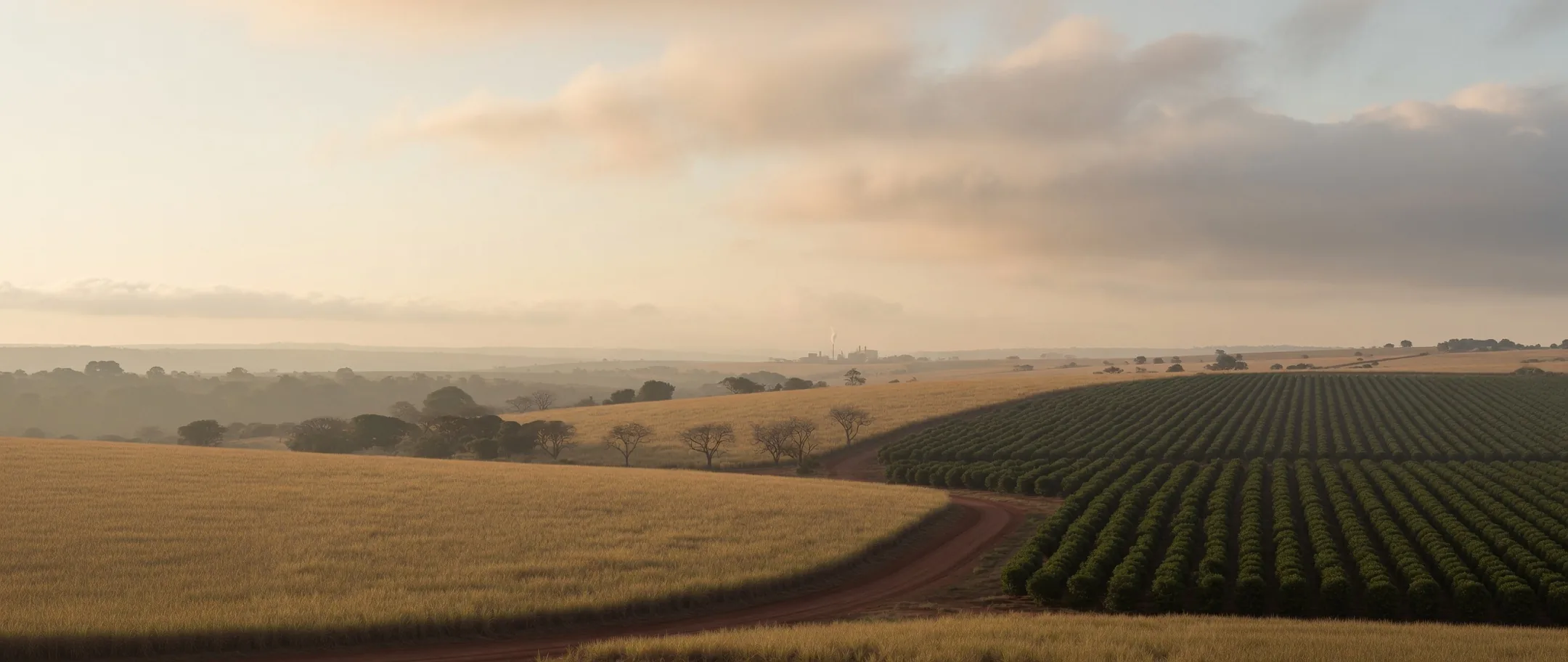
Monte Alto is a town in the state of São Paulo, embedded in an agro-industrial cluster with a high availability of residues from agriculture and processing industry. There we are developing a biomethane plant that processes a diversified mix of regionally available residues — vinasse, bagasse, filter cake, and organic residues from agriculture and agro-industry.
The build-out proceeds in two phases: in the first phase the plant starts with a medium processing capacity, and in a later second phase it is expanded to its full target scale.
Regionally anchored. Substrates come from the region, construction work goes to regional firms, logistics is local — and the end product (biomethane and biofertilizer) flows back into regional supply and value-creation cycles. What the plant generates stays within the catchment of the Monte Alto micro-region. The specific opportunities this opens up for substrate suppliers, construction service providers, logistics, off-takers, and the town itself are detailed on the For the Region page.
At a glance
Plant and Technology
Multi-substrate processing with an adapted temperature regime, with an integrated digital tech stack for substrate management and logistics control.
To the plant →Phased build-out
Two stages — Phase 1 at medium capacity on complete general infrastructure, Phase 2 as a modular extension on a pre-installed base.
Learn more →For the Region
What the project means on the ground for substrate suppliers, construction companies, logistics, off-takers, and the town of Monte Alto — five stakeholder groups, in concrete terms.
Local opportunities →Build-out phasing logic
Regulatory framework
The project is embedded in Brazil’s regulatory framework for biomethane, in particular the Lei dos Combustíveis do Futuro (Lei 14.993/2024) with its biomethane blending strategy and the PNBB program (Programa Nacional do Biometano).
Permitting with the responsible Brazilian authorities — CETESB (environment) and ANP (energy / biomethane specification) — will be pursued during project development. A later connection to RenovaBio with CBIO certificates is envisaged as an option — depending on market developments and the certification effort.