For the Region
What the project means on the ground for substrate suppliers, construction firms, logistics, offtakers and the town of Monte Alto.
What the project means on the ground
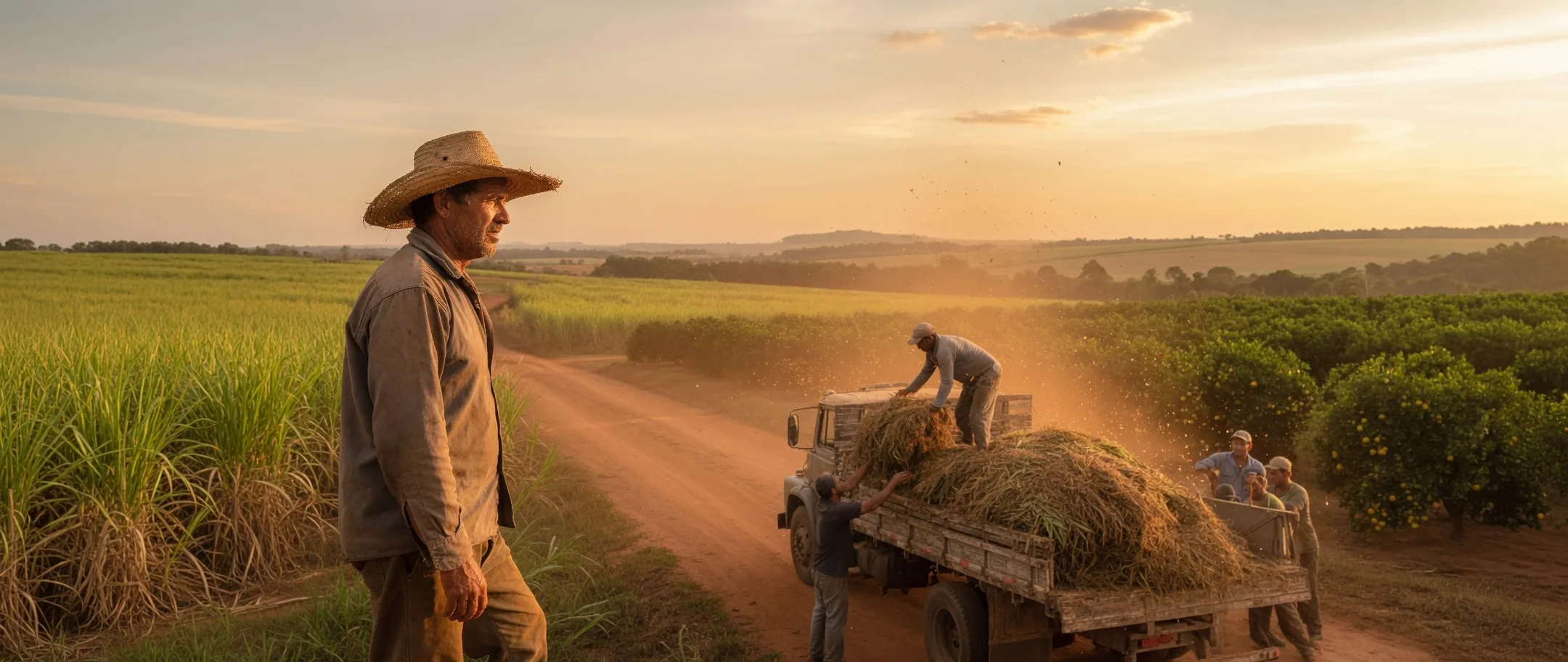
Monte Alto Biomethane is more than a plant. The project is being developed within a dense network of regional stakeholders — and the economic cycle the plant creates closes locally. Substrates come from the region, construction work goes to regional firms, logistics is local, and the end product — biomethane and biofertilizer — flows back into regional supply and value-creation cycles.
That is the central idea: regional value creation rather than extractive large-scale projects. What the plant generates stays within the economic catchment of the Monte Alto micro-region rather than flowing elsewhere.
This page sets out concretely what the project means for five key stakeholder groups.
1. Substrate suppliers — a new, predictable buyer for residues
These stakeholders continuously produce organic residues today that in many cases have to be disposed of, stored or transported away at a cost. The Monte Alto plant creates a regional buyer with long-term, predictable supply relationships:
- Reliable offtake of residues on a regular schedule, secured by contract
- Payment instead of disposal costs — residues shift from a cost factor to a source of revenue
- Reduced in-house storage and disposal logistics, because substrates are called off directly via just-in-time scheduling
The plant’s multi-substrate architecture is explicitly designed so that several substrate types are processed in parallel — this spreads risk across all parties and makes the plant independent of any single source.
2. Construction service providers — regional construction contracts over several years
The project is planned as a phased build-out in two phases — meaning two construction waves, each with its own contract volume:
- Phase 1: build-out of the general infrastructure (civil works, supply corridors, SCADA backbone, safety and logistics corridors) plus the first processing stage — a substantial construction phase with a clear regional share
- Phase 2: modular expansion as a tie-in on pre-installed infrastructure — a second construction phase on the same site
We aim to award a relevant share of these construction works to regional companies, as far as this is compatible with international funders’ requirements for quality, compliance and construction sequencing.
3. Logistics companies — continuous substrate and product logistics
The plant generates lasting logistics demand across the entire operating period:
- Substrate collection from the regional catchment area on just-in-time schedules
- Storage and buffering logistics for seasonal substrate peaks (harvest periods)
- Distribution of the biofertilizer (digestate) to regional farmers
- Biomethane distribution (pipeline injection or liquefaction as LNG/CNG for transport)
The project’s digital control layer is explicitly designed to optimise these logistics flows — shorter routes, fewer empty runs, higher utilisation of regional logistics providers.
4. Offtakers — farmers and biomethane consumers
A locally available, continuous biofertilizer stream is created for regional agriculture. This means:
- Reduced dependence on imported mineral fertiliser
- Lower transport costs compared with supra-regional fertiliser supply chains
- Closing the nutrient cycle in the micro-region: what goes into the plant as a residue from the fields and usinas comes back to the fields as biofertilizer
Pipeline-grade biomethane is a sought-after product in the Brazilian energy market — anchored in the Lei dos Combustíveis do Futuro (Lei 14.993/2024) and in the Programa Nacional do Biometano (PNBB). With Monte Alto, a reliable regional source is created that can be injected into the pipeline network or made available for transport purposes (LNG/CNG) as needed.
5. The town of Monte Alto and neighbouring municipalities — regional value creation and cooperation
For the town of Monte Alto and the surrounding municipalities, the project means several concrete effects:
- Tax and levy revenue over the construction and operating period
- Jobs both during the construction phases (skilled and unskilled work) and in ongoing operations (plant engineering, substrate coordination, logistics, maintenance, administrative functions)
- Regional value creation instead of residue export: what arises today as an organic residue is converted into an energy product on the ground — the value chain stays regional
- ESG and climate positioning for the micro-region: the project is embedded in the national biomethane framework and gives the region a profile that connects to further energy and sustainability initiatives
- Cooperation across municipal boundaries: interested neighbouring municipalities can participate in the substrate pool and the logistics architecture — in time, a pipeline of further sites is methodically prepared
The cooperation with the town of Monte Alto is formally anchored in the Conselho Administrativo do Programa de Biogás Alemanha-Brasil.
Interest, enquiries, participation
Anyone interested in the project as a substrate supplier, construction firm, logistics partner, biofertilizer offtaker or biomethane consumer can reach the consortium via the contact page.